If there’s one thing I’ve been surprised by while trying to start startups, it’s the extent to which the business landscape is shaped by law.
Skin Cancer
One of my first serious startup business efforts involved skin cancer: melanoma, specifically, by far the most malignant and dangerous type. It turns out that one can really do a pretty good job in terms of detecting melanoma in the early stages, when it’s still relatively easy to treat. This is in part because it is a cancer on the surface of the skin, and typically the cancerous, rapidly multiplying melanocytes produce an excess of melanin in patterns of characteristic irregularity. In other words, one can spot melanoma in ugly moles. If (a) one knows what to look for and (b) actually does look, in the vast majority of cases you can catch the disease before it spreads, and thus, save a life. The World Health Organization pegs melanoma deaths at 48,000 per year.1

The ABCD's of Melanoma. Part of the ABCDs for detection of melanoma. On the left side from top to bottom: melanomas showing (A) Asymmetry, (B) a border that is uneven, ragged, or notched, (C) coloring of different shades of brown, black, or tan and (D) diameter that had changed in size. The normal moles on the right side do not have abnormal characteristics (no asymmetry, even border, even color, no change in diametry).
The chain breaks in both places. There are papers2 that estimate the sensitivity of physicians to melanomas at 86%, which is not bad, if they happen to look, but not great either. The big problem is that it’s by no means certain that the doctor will look: most melanomas are still found first by the patient. That is, if they’re found at all before it’s too late.
A friend of mine refused to see a dermatologist, despite her friends urgings. Once she finally did, the cancer had grown out of control. She did survive, but she had to suffer through an extremely painful excision followed by reconstructive surgery followed by a recovery period nearly a year long. Prevention and early detection are the key weapons against disease.
This could have been prevented. There’s a heck of a lot you can learn from a photograph, even one taken from a cellphone. From that photograph, a trained individual can determine whether the mole is a cause for concern — whether you’re really just fine or whether one should be examined more closely by a specialist. There are even papers showing how an algorithm can be made to be as accurate as physicians in diagnosing the cancer.3
It seemed like a great hack. Within a week or so, I rallied some friends of mine, threw together an application to Y Combinator, and tried to put a business together.
Whatever the technical challenges were, I was unprepared for the legal and social challenges I was to face. The partners at Y Combinator did like the idea on some level, but declined to fund us. In Paul Graham’s words
“The trouble with the melanoma detection idea is that you’d spend most of your time dealing with legal and regulatory crap. That sort of work doesn’t really take advantage of your skills.”
There were other problems too (we were rather cavalier about the quality of images we’d get in practice from widely varying cameras, lenses and lighting conditions), but in the end it was the specter of law and regulation that cowed us. I still maintain that we could build this, and while perhaps it might not have been the absolute best focus for my efforts or launching point for my career, I still think we could have done a lot of good.4
What concerns me most isn’t that we couldn’t get the melanoma detection idea to take off. It’s that anyone trying to work in the field of medicine is going to have to slog through legal and regulatory crap. There’s a lot that can be done with simple little pieces of software and hardware to help people look after their health. Detection is the first line of defense. But as long as we persist in the current regulatory environment, where detection aids must disclaim whatever they imply or slog through the same lengthy and expensive FDA approval process regardless of their capacity for harm, entrepreneurs, engineers, doctors and scientists are going to be limited in the good that they can do, as well as the bad. Lesson one.
[JessNordell notes that both SpotCheck and SkinScan have taken up the charge! ]
The Electrical Grid
It doesn’t take too long before the familiar seems sane, and what we grow up with seems to have always been, bequeathed to us by ancestors blessed with the virtues of invention, vigor and foresight. I remember, as a kindergardener, when my mother took me to the local power plant, chimneys three hundred feet tall, how awed I was by the sights and sounds — the enormous burners and boilers, steam blasting through turbines powering vast generators, electrons pumping through transformers in gray substations of metal ringed insulators, transformers, cylinders, a geometrical landscape adorned with fins, cathedrals of wire, lines buzzing. Deep sounds metal clangs reverberated through the boiler room, amid hot steel, as my tiny feet traced halting paths along innumerable iron grates. Six years old, seeing this, I imagined the builders of these machines surely must have known what they were doing. Promethean gods walked the earth: behold! This was their handiwork.5
It shocked me to find out how the electrical grid really worked.
The grid, as it exists today, has almost no capacity to store energy. This means that at every instant in time, the amount of energy going on to the grid must almost exactly equal the amount of energy coming off. Otherwise, the grid rapidly fails in its operation, rising too high or too low in voltage, or shifting frequency, or succumbing to noise, spelling disaster to everything dependent upon a smooth, steady stream of power for its operation. That is to say, nearly every device of the modern world.
And while we have some provisions to redirect power on the grid (primarily, giant, motor driven switches of a kind not unlike those which control your household lightbulbs), our ability to throttle the amount of power we put onto the grid is slow and expensive. Gas turbines are the power plants that can be controlled most readily, however their power must be throttled over a period of nearly 15 minutes. When they do this, however, they operate away from their most efficient operating point, meaning that lots of fuel is burned, power is expensive, and more CO2 goes out the stack into the air. Hydropower stations can be throttled nearly as readily as gas turbines, but they can operate in a wider range before they lose most of their efficiency. Coal, petroleum, and nuclear plants, on the other hand require periods on the order of days to speed up and slow down — it takes about that long for them to relax to a thermal equilibrium, keeping thermal stresses within safe bounds.
However, the electrical demand is quite unpredictable, and it can vary significantly in a period much shorter than the 15 minutes it takes for our fastest power plants to significantly alter their power output. So to respond in faster timescales, power plants must run as ‘spinning reserves.’ This is where fuel is burning and the turbine is spinning, constantly, in expectation of a fluctuation. There are now massive power plants, burning fuel this very second, for no purpose other than to smooth out the rapid fluctuations on the grid. I hope I don’t need to point out how crazy this is.
What’s more, electrical supply from renewables is very unpredictable, especially whatever’s coming from distributed power. Wind power is the least expensive (in fact, according to Prof. Marc Jacobson of Stanford University, considerably less expensive than coal power!)6, but in terms of supplying controllable, usable power, wind is terrible! Wind power varies rapidly and widely, is extremely difficult to predict, is quite correlated over large regions, and, what’s probably the worst, wind power comes mostly in the dead of night, when nobody needs it.
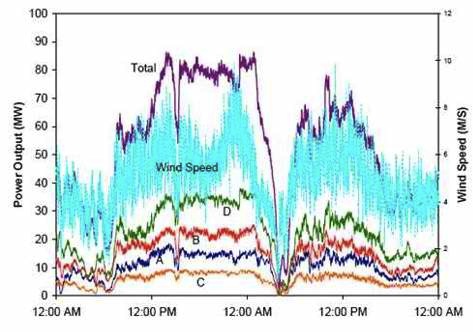
Two days of output and wind speed from a four section wind farm. See the sudden drop? That's why we need energy storage if wind is to be a major part of our grid.
The entire world has wired itself up with an electrical grid that is fundamentally insane, and as we plug in renewables to solve the other problem with the electrical grid, controlling it is only getting harder.
We need a way to store energy. The current state-of-the-art8 is pumping water up a hill to store energy (essentially using a hydropower plant backwards), and letting it run down to retrieve it. This works well and is relatively inexpensive if you have the ideal geography, but those plant sites are mostly taken up: from now on pumped hydro energy storage is either going to be a lot more expensive or a lot more exotic (current plans call for giant undersea bladders, or the use of enormous underground aquifers).

Pumped Hydro Energy Storage
There are a number of other energy storage technologies, including electrochemical batteries, flywheels, and compressed air. There are good people working on every one of these approaches, and from our perspective, technically, there’s a good chance that at least one of us will find a solution allowing for energy storage so efficient and inexpensive that renewables, especially wind power, are economically competitive on the world scale, and on an unsubsidized basis.
However, among the many obstacles we find along the way appears the government. Despite their problems, technologies now exist that can both regulate the grid on short time scales (that is, dampening the second to second and minute to minute fluctuations) and, over a longer period, buy unneeded power in bulk at low prices and sell it when needed at high prices. If, on a single device, you can only provide the short or long term service, the economics don’t make sense. Luckily, it is technically feasible to do both simultaneously, on the same device, and thus the economics for the current technology can work out, in at some cases. The electrical grid can be buffered by energy storage, and utilities could make money doing it, to boot! How sensible.
Unfortunately, it’s illegal!7
Let me explain.
Transmission assets, like roads, railways, telephone networks and the electrical grid, have been shown to naturally tend towards a monopoly. In the case of the electrical grid, after a number of political fights the following deal was struck: the government would grant the electrical grid transmission monopoly to a single entity (in some cases more specifically the last few legs leading from the power plants to your home) in exchange for certain powers. In particular, the utility could, using its monopoly pricing power, impose practically any price on the unwitting public, which would pay just the same — they have almost no choice and electricity demand is notoriously inelastic. However, it would be restrained to charge a price only up to a certain regulated return on their capital, and no more. The regulatory commission has other powers, such as being able to define which sorts of investments and projects can proceed, and it places on the utility certain contractual demands to supply power.
Therein lies the first problem. In effect, were one selling power equipment for the grid, one’s real customer is not the utility, but the regulatory commission. It’s in the utility’s interest to buy the most capital intensive equipment that the regulatory commission will allow, and to incur the greatest expenses. After that, it may jack up prices such that it achieves its regulated rate of return, but now, due to its greater expense, it is now earning a greater profit as a greater entity for more investor dollars.
I never imagined such a perverse set of incentives. There are only three reasons for which utilities regulated in this way will look beyond the most expensive corner of the status quo. Firstly, in order to reduce risk on their capital investments, secondly, to explore the use of alternative technologies and broaden their strategic options, and finally, out of the goodness of their hearts. They’ve actually done a lot on that last count; that renewable energy is deployed at all seems to me shining evidence of a desire to do good. But utilities are conservative organizations, they’ve already figured out how to run their capital investments with very low risks (lower than most new technologies could possibly manage) and dollars for technology exploration are in short supply.
So, there’s the first shocker. Utilities with a regulated rate of return (I think this is most of them, though I’d love a better quantification for this) have essentially no incentive to save money, and hence no incentive to try out new money saving technology. If we’re to sell to anyone we have to sell to the regulatory boards, who are even more conservative. Oy.
Secondly, as the government is fond of doing, parts of the electrical utility business have been broken up, and they are not even allowed to talk with one another and share information, much less operate with the same hardware. The transmission department at PG&E is kept sealed off from the generation department at PG&E. Unfortunately, despite the fact that it is ludicrous, that it is patently insane to operate an electrical grid without energy storage (just as it’s insane to operate a network with no buffer, a computer with no cache or memory), there is no energy storage department at PG&E, or at least it doesn’t fit into the existing regulatory structure. There are no requirements for a certain amount of energy storage, and even the things that you could do to save money for the utility are unattractive for the reasons described above, and even those are unlikely with current technology to be good investments because they are both risky and it is illegal to operate the same device for both the generation department (people are saying now that storing cheap energy at night and selling it at a higher price during the day is called ‘generation’ for some reason) and the transmission department (regulating short term fluctuations in the grid and storing energy to ease congestion is called ‘transmission’ for some reason). So, a sensible and practically necessary thing (energy storage) is not allowed to be run in a manner which with existing technology which could save the public and the utility money and could enable the economic competitiveness of renewables. But that doesn’t matter because utilities aren’t trying to save money anyway.
Wow.
A couple of these problems can be avoided in the new, deregulated, ‘ancillary services’ markets. These deregulated markets, humorously enough, are markets for regulation — utilities and electric co-operatives pay a premium for MW scale power slices, so as long as you’re in the right spot and can deliver power on extremely short notice (people are pushing this as short as 4 seconds) you can stand to make a fair bit of money on a deregulated market selling to utilities. There are a few companies (Beacon Power is a prominent one) that try to make systems to do this now: in addition to the technology they’ve developed they’ve put in an incredible amount of political effort to get utilities to open up and deregulate their (*snicker*) regulation markets.
Unfortunately, the economics are still somewhat marginal. Current energy storage technologies are really expensive compared with the wasteful throttling of fossil fuel power plants. Better technologies (we’re working on one) might be able to make a really substantial profit. And if you can do energy arbitrage (buying power low, selling it high), or do something else that’s useful with your energy storage device, you can make even more money. Unfortunately, as above, it’s illegal to sell regulation services and do energy arbitrage on the grid — you have to do something else. (If any investors are reading this, don’t worry, we’ve got a few tricks up our sleeves!)
Someday, by our actions and with the help of others, enough of these problems will be solved so that the electrical grid can be buffered and made sane, that the public will save money by using energy storage, and renewable energy will be free to take over the world.
Someday.
Until then, we’ve got a lot of work to do. Here I thought we were working on a complete, technical solution to solve a massive problem in the world. A straight shot. And what do we find? Legal and regulatory crap, my nemesis, as defined by Paul Graham.
Lesson two.
So it goes.
A Patent Puzzle
Inventing things is what I do. It’s an inseparable part of who I am. I can’t get three chapters into a book before I have an idea for a new technology, product, startup, or hack. Parties are brainstorming sessions. I pester romantic partners as we fall asleep.
Some of my ideas are good. Some, not so good. Those that pass all my filters probably each have a decent shot at solving a major problem in a way fundamentally better than what’s come before with an approach that’s within my eventual capability to execute. Maybe it’s a little better than 1 in 3. I can’t really know until I try. But because I have so many ideas, and possibly because of practice, they number in the hundreds. If they were they only idea I had, I could really see myself giving them a go. And succeeding. I am not at all unique in this.
One thing that helps tremendously is to be able to talk about one’s ideas. Maybe even bring another person in to help work on bringing them to life. Oftentimes one’s ideas are too much for one to handle at some time, or maybe one is missing some crucial missing piece that needs just the right person or the right piece of knowledge.
If good ideas are too plentiful to fully utilize by oneself, if the difficult part of profiting from a good idea is bringing them to life, and if being open about them aids in this process, then ideas should be free.
Or, at least, it should not make one unduly vulnerable to reveal one’s ideas. One should at least be free to let one’s ideas free.
My friend, let me tell you about the patent system.
If I hold a patent on something (a widget), it does not allow me to build, license or sell the patented widget. It merely allows me to prevent others from building, licensing, or selling that widget (or anything else that falls under the widget classes and widget constituents for patented widget uses under the widget claims).
If my widget involves some device (a sprocket) that someone else (Eve) has patented, Eve can prevent me from building, licensing, or selling my widget unless I purchase a license for Eve’s sprocket.
If my something absolutely requires some crummy little item (a doohickey) that I forgot to mention or didn’t quite yet invent in my papers, my blog posts, my patent applications or my brochures, the sum total of my disclosure to the public domain and the patent office, and Eve notices this, she can patent said doohickey and the rational use of her doohickey and extort an outrageous price from me before I can sell any widgets at all.
Herein lies the problem.
Race to the Sea!

The Race to the Sea of the First World War, 1914. While the war was still mobile, both sides attempted to find an open flank. This began a race that ended when it reached the sea. Before these lines were drawn, armies were mobile. Afterward both sides became mired in grueling siege trench warfare from nearly unassailable positions. An analogy with patent strategy is apt: intellectual property is territory, and you do not want to be surrounded.
If you mention almost anything specific about what you’re doing and how you’re doing it, then you’re making yourself vulnerable. Eve can now take a look at what you’ve done, run through possible improvements, and possible requirements that you either have not claimed or disclosed or have not invented yet, and patent the ones that will hurt the most. Once you’ve given away your position, she can surround you, choking you off from the possibility of profiting from your work.
The important patent on the sewing machine was the sewing pin. With a tiny little hoop through the head. It is easy to forget the little things.
In the current legal climate, there are three options.
1. Stay hidden indefinitely. Protect everything that you’ve got by trade secret. If you personally (with or without corporate backing) expect to be able to bring your ideas to their full potential, this might be best for both you and the world.
2. Race to the sea. Patent your work — stake your ground, and reveal your position. Once your first patents are filed, you have to, urgently and carefully, check to make sure you’ve thought everything through. Are the relevant uses and markets patented? Are all of the incorporated or required devices available as commodities, or public domain, or inexpensively licensable, or do you own those patents yourself? Are you absolutely sure that you haven’t left anything critical out — that there’s nothing that you still need to invent that someone else might patent first? Are substantial improvements and variants of your design included in the first patent? There is a relatively short delay (on the order of a year) between when you file a patent and it appears for publication. If any of the vulnerabilities describe above exist, you’ve got until the publication date to protect yourself before Eve can make her attack. The clock is ticking.
3. Use your judgment, talk and write as freely as you desire, and cross your fingers. Hope that no one patents around you, and no one litigates.
I personally would love to be able to open source many of my patentable ideas. Engines. Desalination plants. Solar collectors. Refrigerators. Waste water mining. Wind turbines. Boats. Planes. A crowd beacon. Medical devices. Heat lamps. Translucent coatings. Metallurgical processes. Bioreactors. You name it. But the legal climate does not make it very safe for me to do so. If I write about them too freely, Eve might patent around me — now neither I nor anyone else can pursue my idea without encumbrance. If I protect myself by racing to the sea, I need to engage in an extraordinary investment of time, energy, and money on an idea that I probably crystallized in three seconds. It’s clear that even in the best of circumstances I’d be rate limited, but for almost all practical purposes this would become an untenable demand on my time (unless I have the resources of Nathan Myhrvold at my disposal.) Finally, I can protect myself by keeping my ideas trade secrets. Unless they are one of the few which I actually find the time and resources to seriously work on, this accomplishes exactly nothing. There is no pile of precious ideas I keep to stroke at night. I do not hoard them.
Some members of the free software community have been brainstorming ideas which have some relevance to tackling this problem. They include the Patent Commons and retaliation provisions in the GPL v3.9 Unfortunately they really do not provide full protection. Patents can only prevent people from building or selling things. They are weapons. Patent trolls, on the other hand, don’t build or sell anything. There is nothing to retaliate with, nothing to counter-sue, there is no center, no target. Patent trolls occupy an ecological niche in the legal landscape equivalent to cell based terrorist organizations in today’s political world. A sufficiently determined and evil person could extract billions of dollars from the world and destroy billions of dollars in wealth via long and painful lawsuits, simply by surrounding the patents and inventions that the world now relies upon. Perhaps at this time our only real protection is how grueling and soul destroying that path to fortune is versus the creation of wealth.
The patent system is supposed to encourage innovation. But I think what it’s done is cause everyone to overvalue ideas, and that has shifted the balance of power away from those who want to turn their ideas into something concrete and towards, marginally, those who have the ideas in the first place, but much more worrisomely, those who wish to wage war with them.
I’d love a discussion on how to fix this system. Specifically, not what to fix, but how: what specific actions can we take to make a difference? Quite apart from this, what should I do? Suppose I want nothing more than to do good for the world, to let my ideas, if they so deserve, blossom fully into life. Just talk about them and hope there’s no lawsuit? I do not want to be thinking about this!
Lesson three.
More legal and regulatory crap. Maybe I shouldn’t be so surprised: without law, there’s no formal property, no real capitalism, pretty much just anarchy, really. Of course it undergirds business. But what’s strange is that it’s constraining my thought. I just want to talk to people about my ideas, help the world, and be good. This shouldn’t be so hard!
So it goes.
Post Script: Trevor Blackwell of AnyBots and Y Combinator gives a thoughtful reply on Hacker News as to how the regulations that come into being are so malformed.
Big companies are smarter than gov’t regulators, they understand their business better, and they have a longer time horizon. So when the government comes around to regulate them, they think “OK, how can we turn this into a huge barrier to entry for new competitors?” They have large lobbyist and strategy budgets. They generally win.
The most misregulated industries in the US are energy, medical, and transportation. So there are lots of glaring inefficiencies, but they are there for a reason. Technologists assume the reason is stupidity and that clever inventions can fix things. Frustration ensues.
References
1 – Lucas, R. Global Burden of Disease of Solar Ultraviolet Radiation, Environmental Burden of Disease Series, July 25, 2006; No. 13. News release, World Health Organization
2 – Delays in diagnosis and melanoma prognosis (II): the role of doctors. Richard MA.
3 – Neural Network Diagnosis of Malignant Melanoma From Color Images, Ercal F. et al.
4 – I was told later by an entrepreneur formerly employed by the FDA that with a sufficiently awesome disclaimer one can put nearly anything on the market (“Nothing this program tells you means anything”) though I am really not sure how well this works in practice. I have read horror stories of the offices of a breast cancer detection aid being raided by the FBI — the case had to go up the the supreme court before they were acquitted.
5 – I do remember, however, challenging my tour guide in the waiting room when my cartoon host ‘Zappy the Electron’ claimed that both electricity and electrons traveled at the speed of light!
6 – Jacobson, M. Z., and G. M. Masters G. M., Exploiting Wind Versus Coal
7 – I should mention that I only know about these problems in the context of the USA regulatory framework. I’m sure there are analogous problems elsewhere, but I have not examined them in sufficient detail.
8 – State-of-the-art if one is considering cost effectiveness, and not energy density! Pumped hydro plants are gargantuan.
9 – This is a good discussion: Copyleft versus Patents: The Open Source Legal Battle, By François Lévêque and Yann Ménière















 Insights by Danielle Fong